The chain vs belt drive garage door opener question comes up on nearly every opener job. Both designs use a motor to pull a trolley along a rail, and the trolley moves the door. In one, a steel chain does the pulling. In the other, it is a steel-reinforced rubber belt.
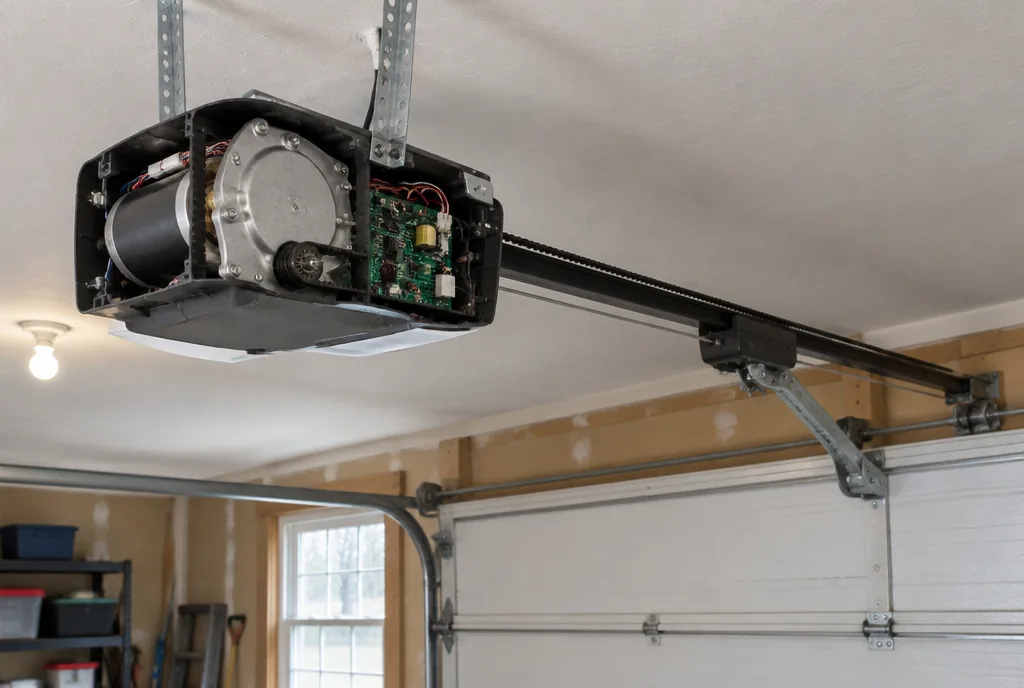
Chain drive openers
A chain drive works like a bicycle chain running over a sprocket. It is the older design and still the most common.
- Strengths. Durable, simple, and usually the lower-priced option. Handles heavy doors well.
- Weaknesses. Metal on metal is loud, and the vibration travels through the ceiling joists. The chain stretches slightly with age and needs occasional adjustment and lubrication.
- Best for. Detached garages, or attached garages with no living space nearby.
Belt drive openers
A belt drive swaps the chain for a toothed belt. There is no metal-on-metal contact along the rail.
- Strengths. Much quieter and smoother, with less vibration. No chain to lubricate.
- Weaknesses. Usually costs more than a comparable chain model.
- Best for. Attached garages, especially with a bedroom above. Many colonials and raised ranches around Attleboro are built exactly this way.
What about cold garages?
Unheated garages in Massachusetts see single-digit nights. Both drive types are built for that. In practice, the cold-weather complaints we hear are about stiff grease on a chain rail or a door that has become hard to move, and the opener type is rarely the cause. A belt has no grease on the rail to stiffen, which is one small point in its favour. Our article on winter garage door problems covers the rest.
Other opener types worth knowing
Wall-mount (jackshaft) openers
These mount on the wall beside the door and turn the spring shaft directly. There is no rail across the ceiling, which frees the space for storage or a high-lift track. They are very quiet. They need a torsion spring system and enough side room next to the door.
Screw drive openers
A threaded steel rod moves the trolley. They have few moving parts but can be noisy and are less common in new installations.
Features that matter more than the drive type
- Motor type. DC motors start and stop gently, run quieter and allow battery backup. AC motors are simple and proven.
- Battery backup. Runs the door during a power cut. Worth having in a region that sees nor'easters and ice storms.
- Lifting power. A balanced door needs little force. Heavy insulated or wood doors call for a stronger unit.
- Rolling-code remotes. The code changes every use, which stops code copying.
- Wi-Fi control. Lets you check and close the door from your phone.
- Safety sensors and auto-reverse. Required on every opener sold in the U.S. since 1993.
The opener is only half the system
An opener moves the door. It does not lift it. The springs carry the weight, and a properly balanced door can be raised with one hand. If the springs are weak or the rollers drag, even a new opener will strain and wear out early. That is why we check balance and hardware before fitting an opener, and why a door with tired springs may need garage door spring repair first.
Repair the old opener or install a new one?
Stripped gears, bad sensors, drifted limits and failed capacitors can usually be fixed, and garage door opener repair is the cheaper route when the unit is otherwise sound. Replacement makes more sense when the opener has no photo-eye sensors, parts are no longer made, the board has failed on an old unit, or the noise is the real complaint. Our guide to a garage door that won't close can help you tell an opener fault from a door fault.
Opener installation in Attleboro
Johnny Garage Door Service fits chain, belt and wall-mount openers. See the details on our garage door opener installation page, or call (508) 709-6644 and tell us about the door, the garage and what sits above it. We will suggest the type that suits the house.